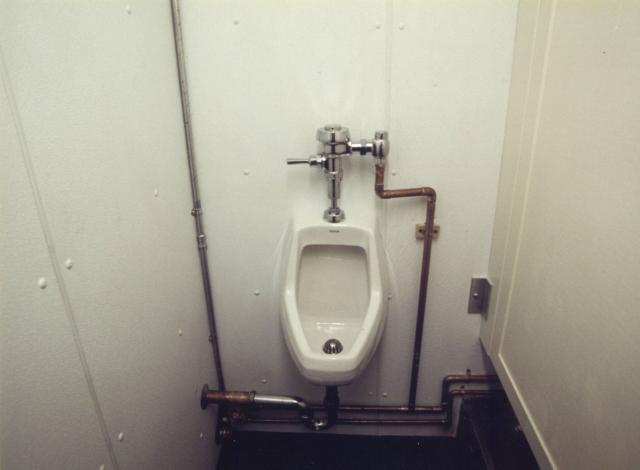
This picture was submitted by Curtis B in 2002. It was taken in the old Amundsen-Scott South Pole Station Building, which was in service from 1975 until 2008. He writes:
"...I spent 26 days in Antarctica... in the process of getting [this] picture. I feel that it in and of itself is a fixture to be admired. One that resides upon the highest, driest, and coldest continent on earth, the very bottom of the planet; one that marks an elusive destination and goal that was not able to even be reached until the early 1900's and carries with it the suffering and the loss of life of several explorers; and one that is at a place that is not only off the beaten path but literally 'miles from nowhere'... In fact, no other urinal in the world or even space can compete with the efforts and loss of life that went into [this fixture's] eventual permanence at the South Pole. What it may lack in beauty it more that makes up for in dignity."
More information about the Amundsen-Scott South Pole station:
""The geographic South Pole (90 degrees South) has long been a prized goal of Antarctic explorers. The first to reach it were four Norweigians led by Roald Amundsen in 1911. About a month later, in January 1912, the British explorer Robert Falcon Scott reached the South Pole with four companions. Scott and his party perished from exposure and hunger on their attempted return on foot to the McMurdo Sound region.
"U.S. Navy Admiral Richard E. Byrd was the first to fly an airplane over the South Pole (1929), but he did not land there. The site was not visited again until 1956, when Navy Admiral George J. Dufek stepped off an LC-47 with an advance party to build the first permanent South Pole Station. The station was established in 1957 for the International Geophysical Year under Paul Siple, first station scientific leader. It continued to function year-round until January 1975, when the present station was occupied."
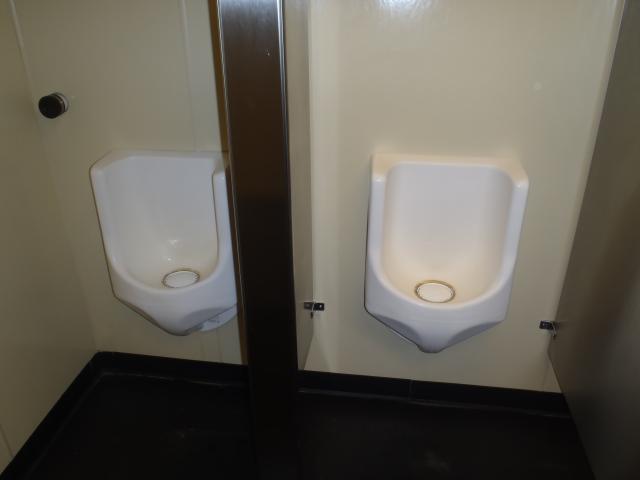
This second photo was sent in by BN in 2012. It was taken in the new elevated station building, constructed between 2003 and 2008. He writes: "I just got back to NZ from visiting the South Pole for a month and have an updated picture of a couple of the waterless urinals in place at the elevated station. I think the picture you have is from the old dome or perhaps one of the science buildings as I was unable to find it during my visit."
The elevated station was constructed starting in 2003 and finished in 2008. Its a better building to support the science being done down there from the old dome used from 1975-2003. I was down there to work on the satellite communications uplinks from mid December 2011 until late January 2012. The geographic south pole is visible out of the windows of the elevated station. The urinal I took a picture of was the bathroom in the A3 wing of the elevated station.
The station only holds about 150 or so people, but up to 250 work during the austral summer. The overflow stays in jamesway tents about a half mile from the station in an area called summer camp. There were several more urinals including the ones in the "Inferno" and "Ice palace" bathrooms out in summer camp where I was staying, but I did not get pictures unfortunately."